Category
Brutally Honest IT Career
Written By
Krutika P. B.
Updated On
Jun, 2026
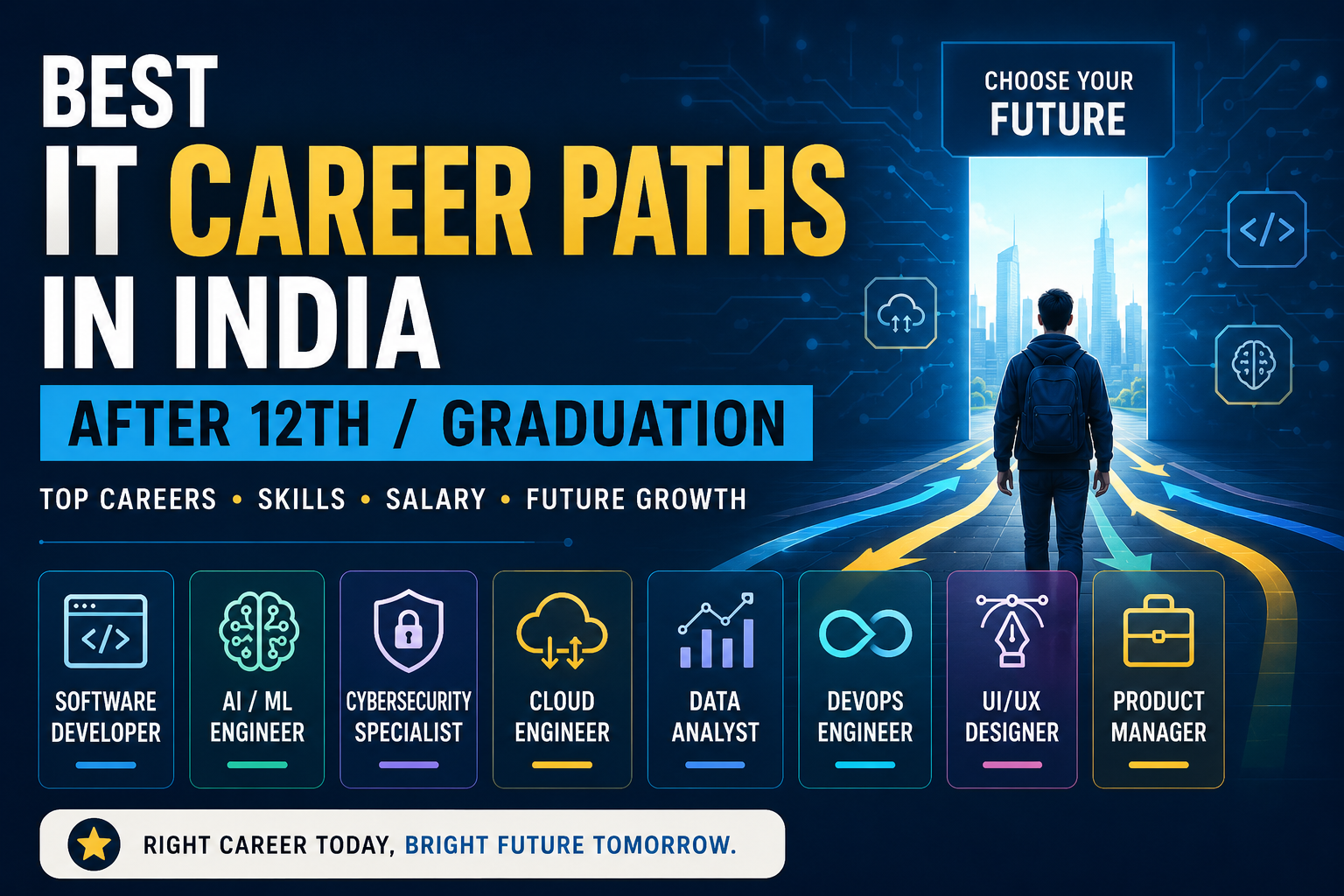
The IT industry remains one of the most attractive career sectors in India. Every year, thousands of students complete their 12th standard or graduation and face the same question:
"Which IT career path should I choose?"
The problem isn't a lack of options. It's the opposite.
Today, there are careers in:
- Software Development
- Artificial Intelligence
- Cybersecurity
- Cloud Computing
- Data Science
- UI/UX Design
- Product Management
- DevOps
Social media often makes every field look like the "next big thing," creating confusion rather than clarity.
This guide will help you understand the most promising IT career paths in India, who they are best suited for, and how to choose the right one based on your interests and strengths.
Why IT Continues to Be a Strong Career Choice
Technology now powers nearly every industry.
Banks use software.
Hospitals use software.
Retail businesses use software.
Governments use software.
As technology becomes more integrated into everyday life, skilled IT professionals continue to be in demand.
Benefits of choosing an IT career include:
- Strong job demand
- Multiple specialization options
- Remote work opportunities
- Freelancing possibilities
- International career prospects
- Continuous learning and growth
The key is choosing the right path instead of blindly following trends.
How to Choose the Right IT Career
Before looking at specific careers, ask yourself three questions:
1. Do You Enjoy Solving Technical Problems?
If yes, careers like software development, cybersecurity, and cloud computing may be suitable.
2. Do You Enjoy Working With Data?
Consider data analytics, data science, or machine learning.
3. Do You Prefer Creativity and User Experience?
UI/UX design and content-focused tech roles may be a better fit.
Your personality often matters more than current market trends.
1. Software Developer
Who Is It For?
People who enjoy:
- Coding
- Problem-solving
- Building applications
- Creating websites and software
Software development remains one of the safest and most versatile IT careers.
Common Specializations
- Frontend Development
- Backend Development
- Full-Stack Development
- Mobile App Development
Skills Required
- Programming fundamentals
- Data structures and algorithms
- Databases
- Version control (Git)
- Frameworks and libraries
Career Growth
Junior Developer → Software Engineer → Senior Engineer → Tech Lead → Engineering Manager
Why It Remains Strong
Almost every technology company needs developers.
2. Artificial Intelligence and Machine Learning Engineer
Who Is It For?
People who enjoy:
- Mathematics
- Logic
- Automation
- Advanced technology
AI has transformed many industries and continues to grow rapidly.
Skills Required
- Python
- Statistics
- Machine Learning
- Data Processing
- Model Training
Challenges
AI is exciting but requires strong fundamentals and continuous learning.
Future Outlook
Excellent for long-term growth if you enjoy technical depth.
3. Cybersecurity Specialist
Who Is It For?
People who enjoy:
- Investigation
- Security
- Finding vulnerabilities
- Protecting systems
As cyber threats increase, cybersecurity professionals become more valuable.
Skills Required
- Networking
- Operating Systems
- Security Concepts
- Ethical Hacking
- Risk Assessment
Career Opportunities
- Security Analyst
- Penetration Tester
- Security Engineer
- Security Consultant
Why It Matters
Every organization needs security.
4. Cloud Engineer
Who Is It For?
People who enjoy:
- Infrastructure
- System architecture
- Automation
- Problem-solving
Cloud computing powers modern businesses.
Popular Platforms
- AWS
- Microsoft Azure
- Google Cloud
Skills Required
- Linux
- Networking
- Cloud Services
- Infrastructure Management
Future Outlook
Cloud adoption continues to grow across industries.
5. Data Analyst
Who Is It For?
People who enjoy:
- Working with numbers
- Finding patterns
- Business decision-making
Companies generate enormous amounts of data every day.
Skills Required
- SQL
- Excel
- Power BI
- Tableau
- Data Visualization
Advantages
Lower technical barrier compared to some engineering roles.
6. DevOps Engineer
Who Is It For?
People who enjoy:
- Automation
- Infrastructure
- Development workflows
DevOps bridges development and operations.
Skills Required
- Linux
- CI/CD
- Docker
- Kubernetes
- Cloud Platforms
Why Companies Need It
Organizations want faster and more reliable software delivery.
7. UI/UX Designer
Who Is It For?
People who enjoy:
- Design
- Creativity
- User psychology
- Visual problem-solving
Not every tech career requires deep coding knowledge.
Skills Required
- Wireframing
- User Research
- Figma
- Design Principles
Why It's Valuable
A product's success often depends on user experience.
8. Product Manager
Who Is It For?
People who enjoy:
- Strategy
- Communication
- Business thinking
- Leadership
Product managers help define what products should be built.
Skills Required
- Market Research
- Product Strategy
- Communication
- Problem-Solving
Career Growth
Product Manager → Senior Product Manager → Director of Product
Best IT Career Paths Based on Your Personality
| If You Like... | Consider... |
|---|---|
| Coding | Software Development |
| Math & Models | AI/ML Engineering |
| Security | Cybersecurity |
| Infrastructure | Cloud Engineering |
| Numbers & Reports | Data Analytics |
| Automation | DevOps |
| Design | UI/UX Design |
| Strategy & Leadership | Product Management |
Common Mistakes Students Make
Following Trends Blindly
Don't choose AI because everyone is talking about AI.
Don't choose cybersecurity because someone on YouTube says it pays well.
Choose a field you can realistically enjoy learning for years.
Expecting Quick Success
IT rewards consistency, not shortcuts.
Most successful professionals spend years building expertise.
Ignoring Fundamentals
Frameworks change.
Tools change.
Fundamentals stay valuable.
Learn:
- Programming basics
- Problem-solving
- Communication skills
- System thinking
These skills remain useful regardless of specialization.
Should You Choose Money or Interest?
The best answer is neither.
Choose:
Interest + Market Demand
A highly paid career becomes difficult if you hate the work.
Likewise, a passion with little demand can limit opportunities.
Aim for the intersection of:
- What you're good at
- What you enjoy
- What companies need
That's where sustainable careers are built.
Final Thoughts: Your First Choice Doesn't Have to Be Your Last
One of the biggest misconceptions about IT careers is believing that your first choice determines your entire future.
It doesn't.
Many professionals start as:
- Developers and become Product Managers
- Support Engineers and become Cloud Architects
- Data Analysts and become AI Engineers
Your first role is not a life sentence.
The real goal after 12th or graduation isn't finding the "perfect" career.
It's choosing a direction, building valuable skills, and gaining real-world experience.
Technology changes quickly, but people who continuously learn remain valuable regardless of the trends.
Instead of asking:
"Which IT career pays the most?"
Ask:
"Which IT career can I see myself improving in for the next five years?"
That's usually where long-term success, satisfaction, and financial growth come together.